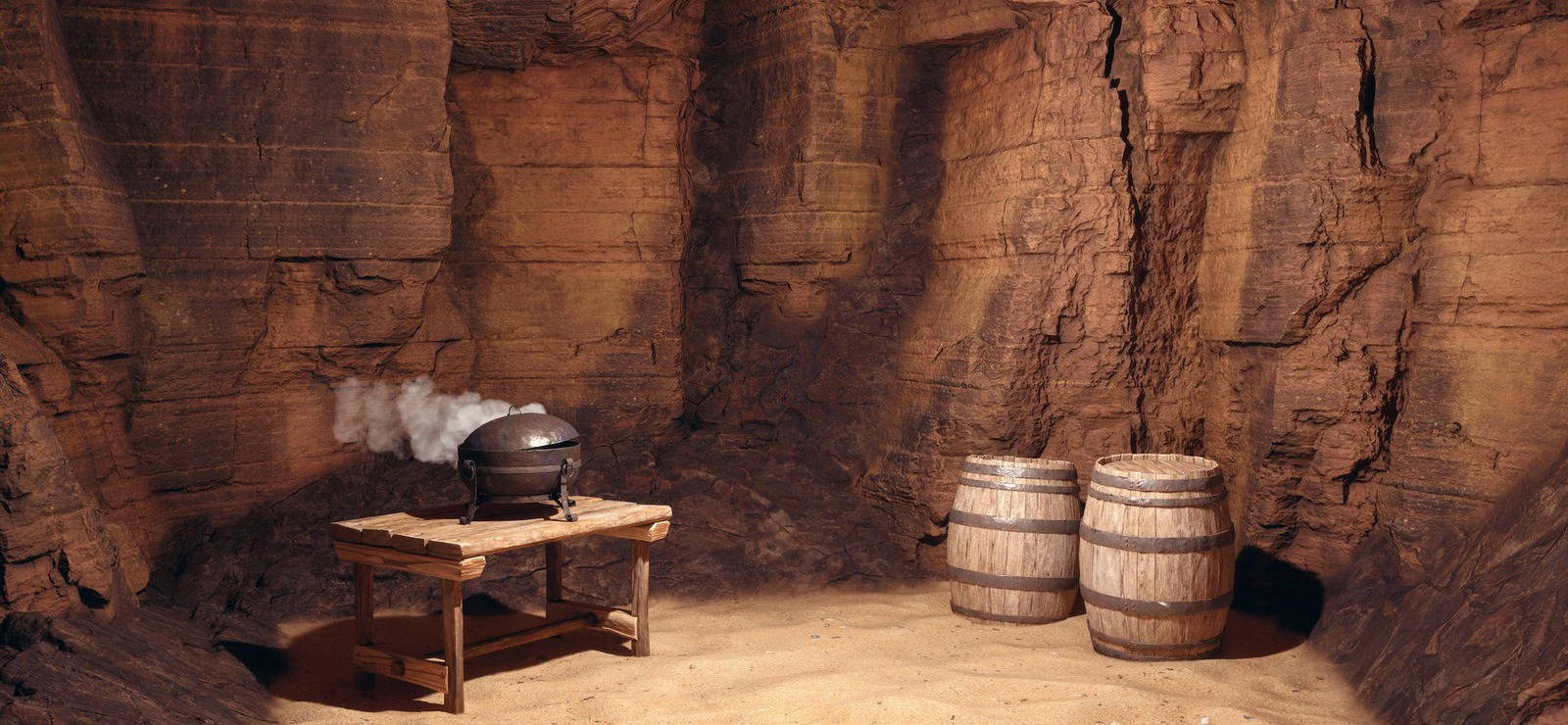
MeshBlend: the new UE5 plugin by Tore Lervik
Anyone working with Unreal Engine knows how important it is to achieve natural transitions between scene elements.
Whether it's integrating a rock into the ground, subtly sinking ruins into the landscape, or blending artificial structures with natural environments, mesh blending has always been a tricky challenge. Until now.
MeshBlend is a new add-on for Unreal Engine 5, developed by Tore Lervik, that promises to revolutionize the way we handle the merging of 3D objects within a scene.
This isn't just another shader or a small utility to add to your toolkit, MeshBlend completely changes the approach to blending, breaking free from the limitations of traditional techniques like RVT (Runtime Virtual Textures) or decals.
Performance and Visual Quality
Despite delivering highly convincing visual results, MeshBlend is remarkably lightweight.
In tests conducted at a resolution of 2560×1440, the performance impact ranges between 0.2–0.4 ms per frame, which is virtually negligible even in complex productions.
To verify these results directly, it is recommended to download the provided demo and consult the official documentation, allowing you to assess the effect and performance within your specific project context.
MeshBlend is designed to integrate easily into existing projects, without the need to rebuild existing shaders or overhaul your material pipeline.
Each master material requires a small update via a Material Function (MF), while not entirely plug-and-play, the implementation is lightweight and well-documented, making integration quick and straightforward.
A Game-Changer for Believable Environments
The creative possibilities are vast: you can blend mechanical structures into sandy terrain, integrate dungeons into moss-covered ruins, or have stylized objects emerge from abstract landscapes, all while maintaining a clean, cohesive look.
It also works seamlessly with cartoon or stylized aesthetics, not just photorealistic scenes.
In essence, MeshBlend helps eliminate that artificial “cut-out” feel often seen at mesh intersections, giving environments a far more believable, polished, and realistic appearance.
How Does It Work?
This is the idea behind MeshBlend.
The plugin operates in screen space via post-processing, which means it works directly on the final rendered image of the scene, rather than complicating your material setup or relying on additional geometry.
The result is an extremely natural visual fusion between objects, with smooth, seamless transitions, all with minimal performance impact.
The best part? It works with virtually anything: static meshes, landscapes, modular assets, and even Nanite objects.
Blending can happen in any direction, not just the traditional top-down approach typical of RVT.
Easy to Use
MeshBlend is designed to be simple and intuitive.
It can be easily applied to any opaque object in the scene and includes several preset sizes (like pebbles, props, rocks, or terrain chunks), all of which are fully customizable.
This makes it equally effective for fine details and large-scale environmental transitions, without sacrificing visual coherence.
On top of that, every parameter can be adjusted in real time.
You can tweak the blending size, enable or disable it on specific meshes, and adapt everything on the fly during runtime.
It’s a dynamic tool built not just for the editor, but also for live scenes, interactive games, or procedural environments.
Below is the official video demonstrating how to install and use the plugin.
Conclusion
MeshBlend isn’t just a technical tool, it’s a creative solution.
It’s designed for those who want environments that breathe, for 3D artists looking for organic transitions between elements, and for developers aiming to close the gap between art and technology.
If you work with Unreal Engine 5, keep an eye on this plugin, it could easily become an essential part of your daily workflow.
You can find the link to the LinkedIn profile here
You can find the link to the FAB page here
You can find the link to Tore Lervik’s X profile here
You can find the link to his YouTube channel here
Latest posts
Free FAB resources - until 20 October 2026
New assets available for free on FAB, available until October 20, 2026

Unreal Engine Animation Studio: The basics of motion in UE 5.8
Unreal Engine Animation Studio: 12 weeks to master UE 5.8 animation tools and bring intention to movement.
MetaHuman Creator Web App: Closing November 5, 2026
Epic Games chiude l’app web di MetaHuman Creator il 5 novembre 2026. Dopo restano 90 giorni per recuperare i personaggi. Le funzionalità restano in Unreal Engine 5.6+. Esporta ora via Quixel Bridge.