Unreal Engine HMI Template: the new Epic Games solution to accelerate the development of automotive interfaces
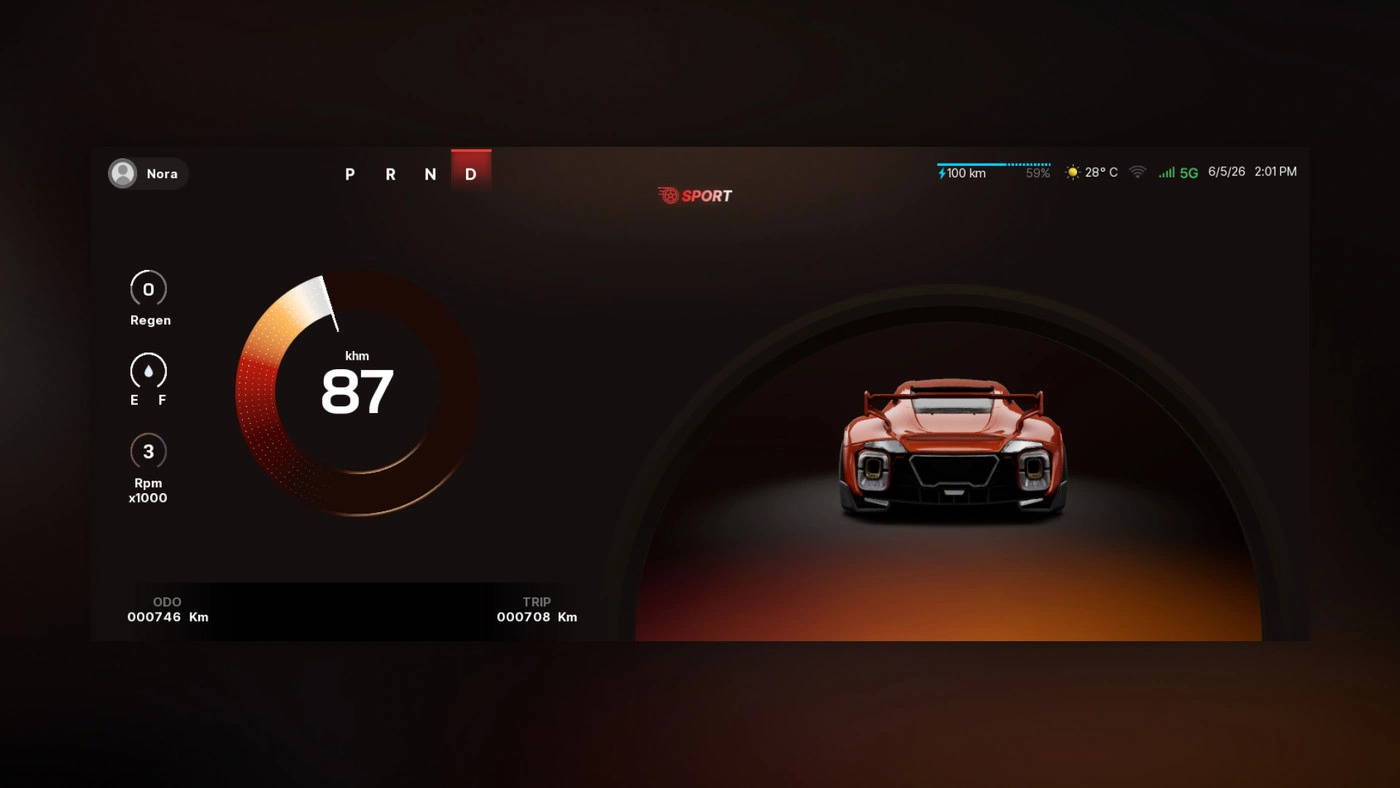
Epic Games has announced the release of theUnreal Engine HMI Template, a solution designed to simplify and accelerate the development of Human-Machine Interfaces (HMI) in the automotive sector.
Available to Unreal Engine licensees in conjunction with the release of Unreal Engine 5.8, the template provides a ready-made technical foundation for the creation of digital dashboards, infotainment systems and vehicle interfaces, significantly reducing the time required for prototyping and technology evaluation.
Unreal Engine and the Automotive Industry
In recent years, Unreal Engine has become one of the most used tools in the automotive industry for the creation of configurators, real-time visualizations and next-generation HMI systems.
The growing demand for increasingly sophisticated, animated and visually appealing interfaces has driven numerous manufacturers and Tier-1 suppliers to adopt technologies derived from the world of video games.
However, developing an HMI system from scratch often requires the creation of a series of common infrastructure components: vehicle signal management, connection to backends, map rendering, optimization for embedded hardware, and construction of reusable UI libraries.
The Unreal Engine HMI Template was created precisely to address these needs, providing a reference framework that is already operational and easily extensible.
A platform designed to accelerate projects
The template is organized into three main areas, accessible through an integrated launcher that allows you to quickly explore the different features.
Instrument Cluster
The first module is a fully functional digital cluster, designed to receive and display vehicle data in real time.
Among the main features we find:
WebSocket support via OLink protocol.
Compatibility with the COVESA Vehicle Signal Specification (VSS) standard.
Management of EV data such as battery level, charging status, range and energy recovery.
MVVM (Model-View-ViewModel) architecture to completely separate logic and interface.
Possibility to quickly replace the included simulator with real vehicle backends.
One of the most interesting aspects is the separation between data sources and UI components: widgets can be reused without changes regardless of the origin of the signals.
Offline map system
The second module is dedicated to navigation.
Epic offers a completely offline solution designed for embedded automotive hardware, with cartographic data loading from a single file generated from OpenStreetMap.
The system uses three distinct rendering layers:
Skia for roads and geographic data.
UMG widget for texts and labels.
Unreal Engine meshes for 3D buildings.
Also available:
Integrated GPS tracking.
Real-time location visualization.
Support for custom buildings imported via .glb files.
This approach allows for high visual quality while maintaining performance compatible with modern automotive platforms.
Widget Library
The third component of the template is a library of ready-to-use widgets.
Thirteen UI elements designed for automotive contexts are included, including:
Speedometer.
Speedometer.
Gear Indicator.
Directional Arrows.
EV Widget.
Weather.
Notification System.
All components can be used individually and integrated into existing projects without requiring additional C++ development.
Data Reduction Pipeline Plugin
Along with the template, Epic Games also presented the Data Reduction Pipeline Plugin, a tool dedicated to optimizing complex assets for embedded platforms.
The plugin allows you to drastically reduce the geometric complexity of models coming from configurators, CAD and advanced visualization pipelines.
According to Epic, internal tests have shown the possibility of reducing scenes with more than 80 million triangles to less than one million, maintaining smooth performance on automotive hardware based on the Snapdragon 8155.
This approach allows you to reuse assets developed for marketing, design reviews or configurators even within HMI systems intended for production.
Who is it for?
The Unreal Engine HMI Template is primarily intended for:
HMI teams at automotive manufacturers.
Tier-1 suppliers.
Integration Engineers.
UI Developers.
Technical Artists.
Teams evaluating Unreal Engine for automotive projects.
Conclusions
With the new HMI Template, Epic Games further strengthens its presence in the automotive sector, offering a solution that addresses some of the most common challenges in developing modern in-vehicle interfaces.
This initiative comes as more and more manufacturers are adopting real-time technologies to create advanced, customizable and visually sophisticated user experiences.
By reducing the need to develop core components like digital clusters, navigation systems, and UI widgets from scratch, the template allows teams to focus more on integrating with vehicle systems and defining the final user experience.
For those in the automotive industry and evaluating Unreal Engine as an HMI platform, this could be one of the most interesting innovations introduced by Epic Games in recent years.
ATTENTION: To request the template, you need an active Perforce license.
For more information and to find the form to request the template, click here.
Latest posts

Free FAB resources - until 20 October 2026
New assets available for free on FAB, available until October 20, 2026

Unreal Engine Animation Studio: The basics of motion in UE 5.8
Unreal Engine Animation Studio: 12 weeks to master UE 5.8 animation tools and bring intention to movement.

MetaHuman Creator Web App: Closing November 5, 2026
Epic Games chiude l’app web di MetaHuman Creator il 5 novembre 2026. Dopo restano 90 giorni per recuperare i personaggi. Le funzionalità restano in Unreal Engine 5.6+. Esporta ora via Quixel Bridge.