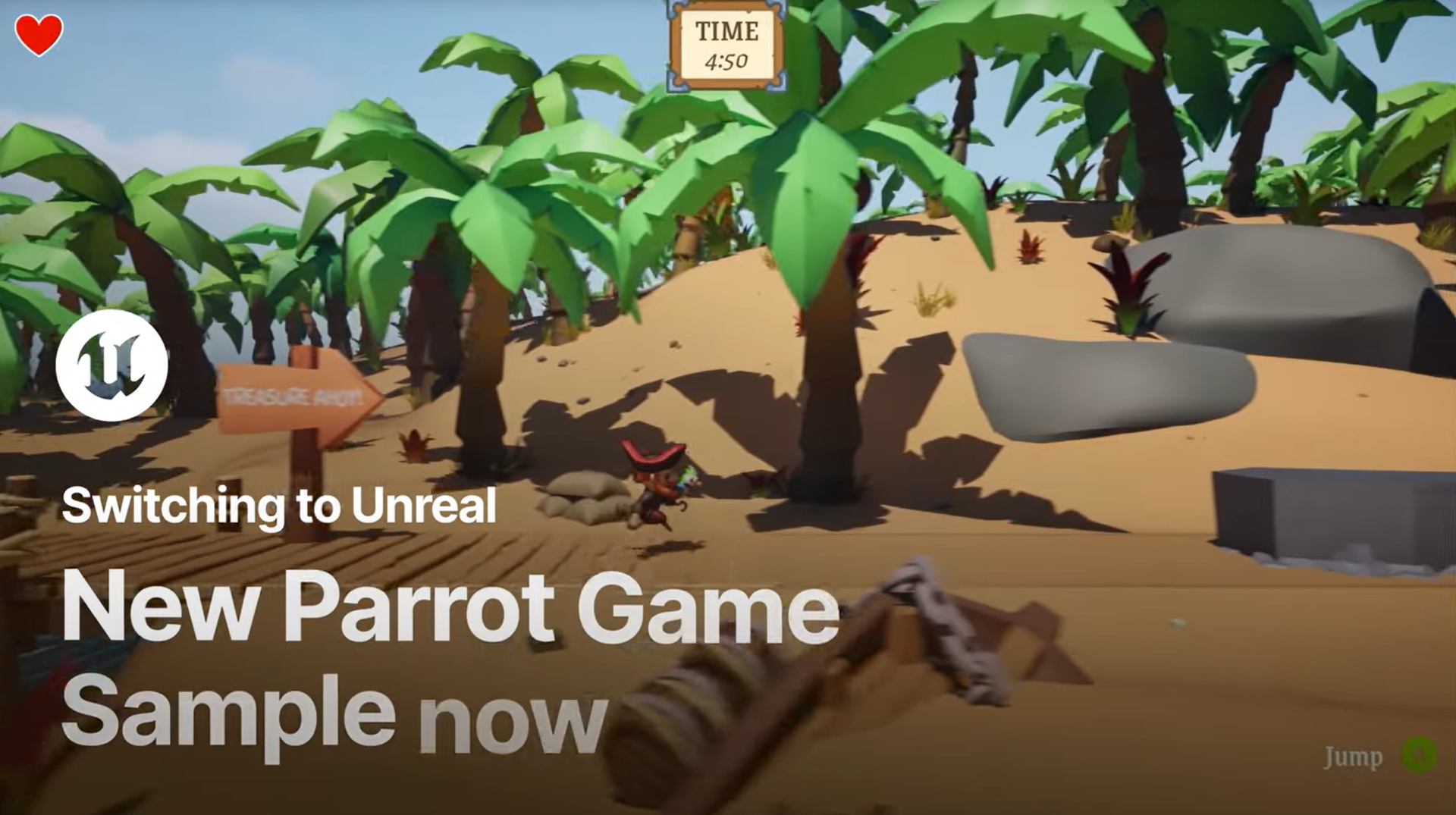
Parrot Game Sample: A New Resource for Switching to Unreal Engine Development
Switching game engines is one of those decisions that can definitely make your palms sweat a little.
Anyone who’s spent years working in Unity knows the feeling: when you're used to certain tools and a familiar way of doing things, the idea of moving to something new like Unreal Engine can feel both exciting and overwhelming.
Still, between changes in pricing models, evolving project needs, or simply the desire to grow technically, more and more developers are seriously considering making the transition.
To support those going through this phase, Epic Games, together with the development team at Secret Dimension, has put together a truly valuable resource: the Parrot Game Sample.
It’s a 2.5D pirate-themed platformer, complete with three levels, a title screen, and a functional menu.
But what really makes it special isn’t the game itself, it's how it was built.
The team actually created the exact same game in both Unity 6 and Unreal Engine 5.6, using the same assets and aiming for as much parity between the two versions as possible.
The goal was clear: to offer developers a concrete, side-by-side comparison showing how the same game mechanics and features can be implemented in each engine.
And they didn’t stop at just building the project, it's packed with annotations, detailed comments, and extra documentation aimed specifically at Unity developers trying to understand how to approach Unreal without getting lost.
This isn’t just a technical demo to observe from a distance. It’s an open, hands-on project meant to be explored, taken apart, and rebuilt as a learning experience.
The code is clean and written according to Epic’s standards, with every system clearly explained.
There are also supporting documents that guide you step-by-step through Unreal’s systems, complete with useful links to official documentation and insights into the development decisions made along the way.
One of the most compelling aspects of the project is its educational intent.
If you’ve worked with Unity, you know that you often need to build your own frameworks from scratch.
In Unreal, many tools are built into the engine—but you have to learn how to use them.
Parrot shows all of this in practice: input, lighting, materials, audio, character controllers, physics, level management, AI using Behavior Trees, and UI built with Unreal Motion Graphics.
Even water, as both a visual and gameplay element, was handled with care.
Originally, the team considered using Unreal’s physical water system, but after some testing, they opted for a more stylized solution using a Single Layer Water Shader.
The result looks great and fits perfectly with the game's chosen aesthetic.
Gameplay was also approached with intention.
The team customized Unreal’s CharacterMovementComponent to deliver responsive and satisfying platforming mechanics, tunable jump height and apex time, smooth fall physics, and all those little touches that make a platformer feel just right.
The camera was designed to follow the player with a one-way system inspired by classic side-scrolling games.
All assets used in the project were released under CC0 licenses, sourced from platforms like Kenney.nl, Quaternius, and OpenGameArt.
This means anyone can freely reuse, modify, and include them in their own projects without worrying about copyright issues.
If you’re thinking about getting started with Unreal Engine, the Parrot Game Sample might just be the best place to begin.
It’s free, complete, and designed to be read, studied, and learned from.
Most importantly, it speaks your language—the language of someone coming from Unity and ready to take a big step forward in developing their own games.
You can find the official Unreal Engine article here
You can find the official Unreal Engine Linkedin post here
Download the project from FAB here
Latest posts
Free FAB resources - until 20 October 2026
New assets available for free on FAB, available until October 20, 2026

Unreal Engine Animation Studio: The basics of motion in UE 5.8
Unreal Engine Animation Studio: 12 weeks to master UE 5.8 animation tools and bring intention to movement.

MetaHuman Creator Web App: Closing November 5, 2026
Epic Games chiude l’app web di MetaHuman Creator il 5 novembre 2026. Dopo restano 90 giorni per recuperare i personaggi. Le funzionalità restano in Unreal Engine 5.6+. Esporta ora via Quixel Bridge.