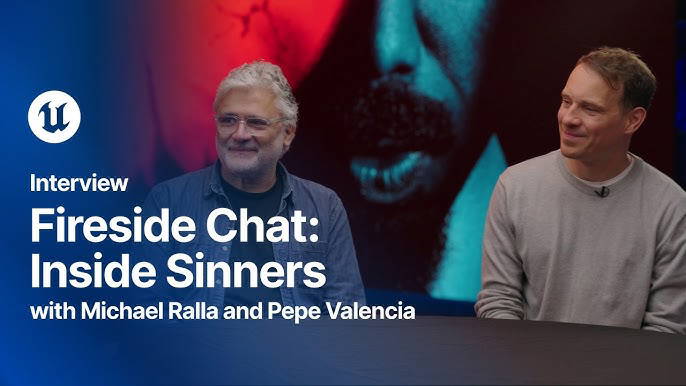
Fireside Chat: Inside Sinners with Michael Ralla and Pepe Valencia
At the heart of the making of Sinners — Ryan Coogler’s film nominated for the Academy Awards in Visual Effects — lies a tool that has become essential for complex productions: Unreal Engine.
But not as a traditional previs tool. Instead, it served as a shared creative space where ideas, storytelling, and technical decisions were explored and aligned long before cameras started rolling.
Real-time visualization: beyond traditional previs
Traditionally, previs is used only in early stages to provide a rough idea of how complex scenes will be shot.
In the case of Sinners, however, Unreal Engine was used as a fully developed visual environment capable of:
simulating both technical and creative details of scenes
previewing the most ambitious shots in advance
helping the director, cinematographer, and technical teams see and agree on solutions before filming
This philosophy allowed the team to make informed decisions about the most demanding moments — from the one-take musical number to the large-scale train arrival sequence — reducing uncertainty and optimizing time on set.
A shared visual language across departments
According to Ralla and Valencia, one of the strengths of this approach was the creation of a unified visual language across departments:
production
directing
cinematography
visual effects
In practice, Unreal Engine acted as a communication bridge, allowing each department to see, discuss, and modify sequences in real time — rather than relying solely on scripts or sketches.
This fundamentally reshaped the production workflow, shifting many technical and creative decisions from post-production into much earlier stages of preparation.
From previs to dynamic post-production
Unreal Engine did not disappear after production wrapped. The generated material was also used during editing and post-production.
For example, the team used real-time visualizations as placeholders to test pacing, cuts, and narrative rhythm even before final assets were ready.
This flexibility made it possible to:
anticipate technical challenges
evaluate alternative framing solutions
support editorial decisions regarding visual storytelling
A new frontier for creative collaboration
During the fireside chat, one key idea emerged: this is not just about technology, but about extended real-time collaboration.
Ralla, Valencia, and Perkins emphasized how working in Unreal Engine transformed previs from a purely technical tool into a shared creative environment where ideas could be tested, discussed, and refined collectively.
This approach enabled the Sinners team to tackle highly elaborate sequences with clarity and confidence from the very beginning of the production process.
Conclusion
The work on Sinners demonstrates that Unreal Engine in filmmaking is no longer limited to virtual reality or previs. It can become a central hub for creativity and artistic decision-making.
Adopting a real-time workflow provided the team with a shared vision of complex sequences — from planning through post-production — enabling more informed creative decisions and stronger narrative control.
Link to the official article.
Latest posts

Free FAB resources - until 20 October 2026
New assets available for free on FAB, available until October 20, 2026

Unreal Engine Animation Studio: The basics of motion in UE 5.8
Unreal Engine Animation Studio: 12 weeks to master UE 5.8 animation tools and bring intention to movement.

MetaHuman Creator Web App: Closing November 5, 2026
Epic Games chiude l’app web di MetaHuman Creator il 5 novembre 2026. Dopo restano 90 giorni per recuperare i personaggi. Le funzionalità restano in Unreal Engine 5.6+. Esporta ora via Quixel Bridge.